Welcome to my website! I am a social scientist (PhD) specializing in political psychology. I focus broadly on the interdisciplinary understanding of how the challenges facing politics today are intertwined with psychological mechanisms. Methodologically, I specialize in quantitative and experimental approaches. My work has been published in journals such as the British Journal of Political Science, the European Journal of Political Research, and The Proceedings of the National Academy of Sciences (PNAS). Beyond academia, I’m motivated to apply these insights to evidence-based communication, analysis, and policy.Curious about my work? Add me to your networks or get in touch via the icons above.
About me
I have experience as a postdoctoral research fellow at the Centre for the Politics of Feelings, and hold a PhD in Political Science from the Norwegian University of Science and Technology (NTNU) and an MSc in Communication Science from the University of Amsterdam. In other words, I am an interdisciplinary scholar whose work sits at the intersection of political science, communication science, and psychology. I practice open and slow science — prioritizing quality, integrity, and societal value in my research. Substantively, I believe quantitative political psychology would benefit from deeper theorization and greater openness to constructivist perspectives. My research reflects this conviction: theoretically grounded, empirically sophisticated, and organized around three interrelated lines of inquiry:
Affective Representation: The affective and psychological foundations of political representation
Embodied Politics: The role of interoception and somatosensory experience in political emotions, ideologies, and identities, and their influence on political attitudes and behavior
Political Marginalization, Radicalization, and Violence: The psychological mechanisms that drive radicalization, extremism, and support for political violence.
Research
Publications
A. Vik, A. Galvez-Pol, S. Park, & M. Tsakiris (2026). Politics embodied: How politics shapes and is shaped by the bodily experience of emotions, Proc. Natl. Acad. Sci. U.S.A. 123 (20) e2534895123, https://doi.org/10.1073/pnas.2534895123.De Wilde, P., Vik A., Treib O., & Aarøe L (2026). "The Impact of Unelected Representatives on Citizens' Satisfaction with Democracy: A Cross-National Survey Experiment". European Journal of Political Research, 1–24. doi:10.1017/S147567652610098XVik A., De Wilde P., Treib O., & Aarøe L (2025). "Venturing Beyond the Vote; Routes to Feeling Represented Through Unelected Representation". British Journal of Political Science, 55, e102. doi:10.1017/S0007123425000080Vik, A (2025). Unelected Representation. In Nai, A., Grömping, M., & Wirz, D. (Eds). Elgar Encyclopedia of Political Communication. Edward Elgar Publishing. Accepted version. Preprint DOI: https://doi.org/10.31219/osf.io/2d5twVik A. & De Wilde P (2024) ."Reconceptualizing Feeling Represented: A New Approach to Measure How Feelings of Political Representation are Constructed". Acta Politica. https://doi.org/10.1057/s41269-024-00358-2
Manuscripts in Progress
Vargui C., Vik A., Nai A., Hino R., & Faye R. “Past Petty Pouting: Perceived Marginalization, Need for Chaos, and Support for Political Violence in the USA and Japan”. Under review.Vik A. “Affective Representation: A Constructivist Framework.”Vik A., Ratnam R. & Tsakiris M. “Bodily Deprivation: Young Men's Bodily Experience of Relative Deprivation.”Vargui C., Vik A., & Nai A.. “Need for Chaos: A Characteristic Adaptation, State or Trait?”Vik A. & Rebasso I. “Toward a Constructionist Theory of Political Emotions".
PhD Dissertation
Vik A., "Unelected Representation: A Psychological Perspective". Norwegian University of Science and Technology. Defended June 2024. https://ntnuopen.ntnu.no/ntnu-xmlui/handle/11250/3144342
Teaching
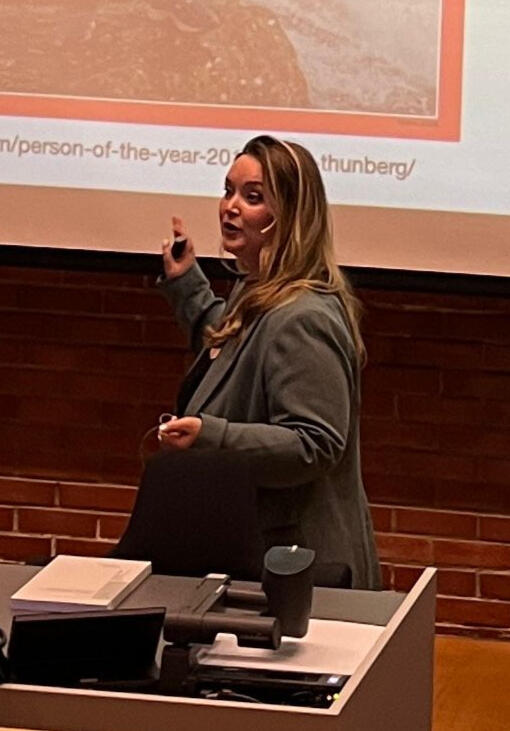
I offer a diverse teaching portfolio encompassing theoretical and methodological courses at both undergraduate and graduate levels. At the University of Amsterdam, I gained exemplary teaching experience as a part-time junior lecturer, teaching Introduction to Communication Theory, Philosophy of Science, and Quantitative Content Analysis alongside my studies. During my PhD at NTNU, I sought out additional teaching responsibilities as a teaching assistant and lecturer, in addition to delivering guest lectures, workshops, and seminars. Students describe my teaching style as engaging, informal, inclusive, and supportive. My teaching portfolio has fortified my commitment to pedagogy and education, and I am passionate about combining scientific rigor with societal returns and contributing to creating decisive value for students and society.You can find some examples of my lectures below.
I founded Hype Club at NTNU, an initiative designed to cultivate a more inclusive and supportive environment for early-career scholars. I see potential in implementing this at more universitities and not only for early career scholars. Hype Club is essentially informal and small research groups to create a support system for academic staff. The goal of the hype club: a safe and positive academic environment. This goal may seem straightforward but it requires an open and honest approach in which no ideas are dumb and we can brainstorm, vent, cheer, address concerns, but most importantly hype each other up to create a more positive working environment. If you are interested you can read more about Hype Club here: